Understanding the Chaos
Middle office responsibilities can vary greatly depending on a firm’s size, market, technology, and structure—but one thing remains constant: when neglected, these functions can become a bottleneck between the front-office investment environment and back-office reporting systems. As the marketplace has shifted over time, the front-office has become more focused on investment selection and performance along with the demanding research that those selections require. This focus forces asset managers and service providers to grapple with the critical need for monitoring trade matching, affirmations, settlements and reporting—activities that are too often viewed as middle office impact only – however, when neglected they can create an organizational crises.
The Roadblocks to Middle Office Transformation
Many firms find themselves ensnared in the complexity of their current processes. They focus on quick fixes instead of designing solutions upfront that meet the end-to-end requirements. Financial service executives need to ask themselves: Are my operations designed to support my goals, or are they a product of the “that’s the way it’s always been done” mindset? A process-centric mentality can cloud strategic vision, leading to inefficiencies and missed opportunities. By adopting a results-driven mindset, asset managers can clarify their goals while at the same time streamlining their workflows, and ultimately enhancing their operational effectiveness. The emphasis should be on achieving desired outcomes, which means prioritizing initiatives that directly impact overall performance and client satisfaction.
Asset managers and service providers can find themselves in a frustrating cycle by trying to make meaningful progress in transforming their middle office while at the same time undertaking their day-to-day operations. Despite a strong desire amongst some asset managers to outsource middle office functions to help realize cost savings, achieve scalable operational models and leverage technological innovations, the reality is that the decision-making phase is merely the tip of the iceberg. Executives must confront the uncomfortable truth that superficial solutions will not address underlying operational complexities.
Once outsourcing is chosen, firms often face slow, resource-intensive implementations, burdened by challenges like outdated technology and complex data integration. These challenges may involve figuring out and unwinding decades of undocumented technology patches/workarounds, alongside complex data integration issues, the need for robust change management strategies, and the alignment of diverse stakeholder interests. Additionally, many firms “don’t know what they don’t know,” making these changes even more perilous. Moving through this maze requires careful navigation and clear strategies to turn chaos into clarity.
A primary concern is the front office's insistence on perfection, which creates unrealistic expectations for performance and results. This demand for flawless execution can lead to frustration and disillusionment when back-office realities fail to meet front office expectations. Moreover, achieving front-office goals often requires the front office itself to adapt and evolve from its existing, or even worse, outdated practices.
Decision-makers often operate with a limited understanding of their current operational complexity, failing to recognize that their processes may rely on many different platforms, applications and vendors to produce the end-product. This lack of awareness can lead to misguided strategies and ineffective implementations which drive delays and increased costs. If your firm is not conducting a thorough audit of its processes and systems, you may be setting yourself up for future failure. There is significant risk when firms do not have clear documentation or the ability to ‘look through’ their business to follow the data and/or identify the root causes for resolving issues.
Organizations also frequently underestimate the importance of connectivity among systems. Effective integration is crucial for ensuring smooth data flow and cohesive operations, yet many fail to address this need, resulting in fragmented processes and inefficiencies. Compounding these issues are the challenges related to data management. Organizations can struggle with data normalization and the complexities of data consumption across various touchpoints, potentially leading to inaccuracies and a lack of actionable insights.
Moreover, the inclination to consolidate operations into a single system may seem appealing, but it can stifle flexibility and inhibit the integration of best-of-breed solutions. Too often, firms evaluate technology solutions based on flashy presentations rather than proven effectiveness, making it challenging to separate credible offerings from mere sales pitches. Once you commit to a vendor, disentangling from underperforming solutions can be a daunting, resource-intensive endeavor. Ask yourself: Are you choosing solutions that truly align with your strategic vision, or are you succumbing to short-term pressures?
Accepting change, as well as effective change management, is a crucial step. Do not start a project if you are not willing to change. This will waste firm resources and will be a culture killer. Firms are reluctant to let go of what has been working for years, but may be inefficient, time-consuming, and resource-heavy. Managers and providers need to take a long-term view to achieve significant benefits. All too often, executives want immediate results that positively impact earnings. It takes investments and resources to achieve large benefits. Similar to when new features come out for the iPhone, it takes time for managers to adopt a new way of working, even if the benefits are clearly laid out. Change management requires alignment among all stakeholders. If even one executive diverges from the defined vision, it can disrupt the entire transformation effort. This underscores the necessity for cohesive leadership and consistent communication throughout the process. Overall, a lack of clear communication and understanding of existing operational complexities can hinder progress, leaving teams feeling as though they are spinning their wheels rather than moving forward.
Begin with Stability
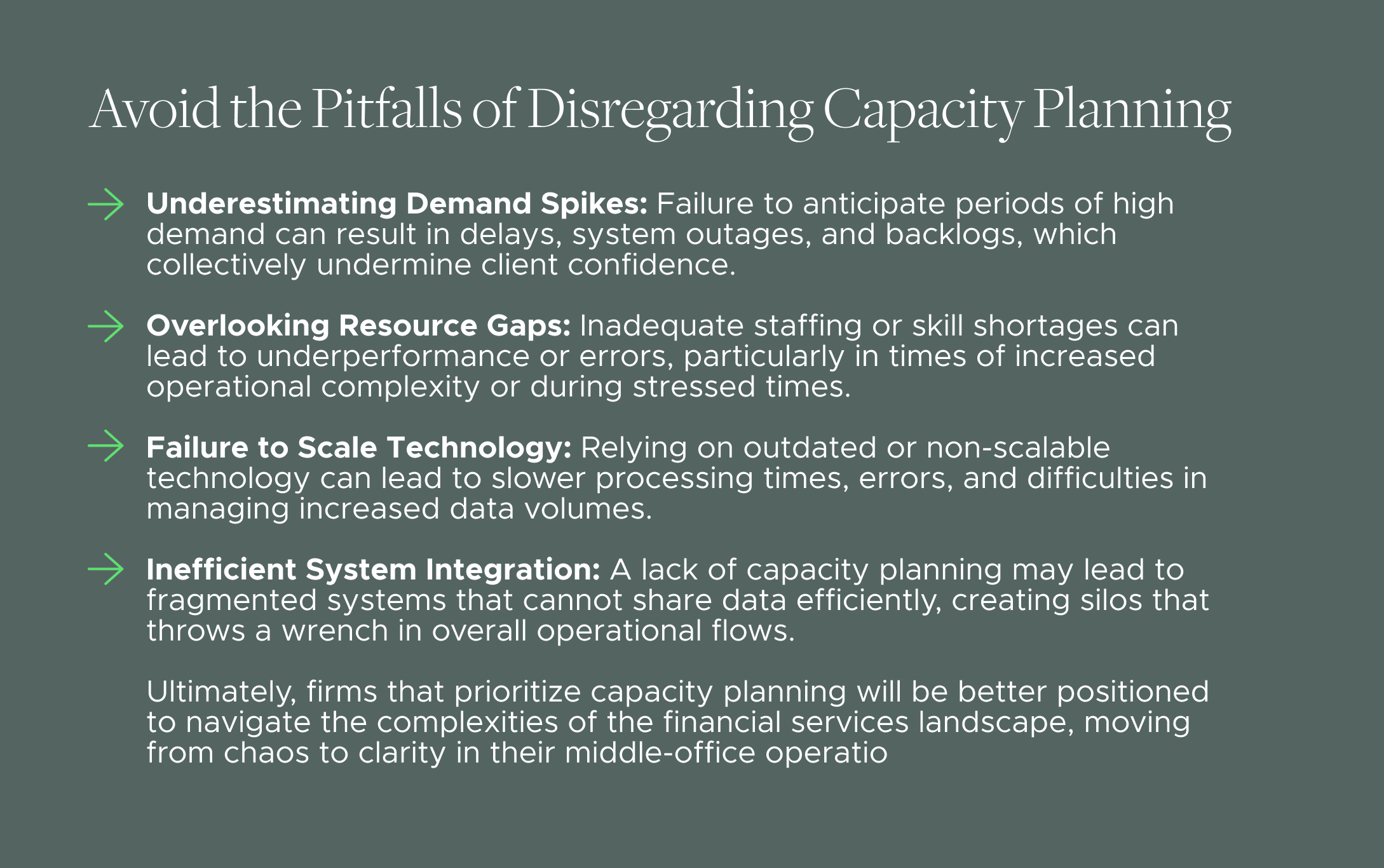
Capacity planning is a critical aspect of middle-office transformation, yet something that does not often get the right focus. Without proper capacity planning, even the most sophisticated systems and processes can become overwhelmed, leading to inefficiencies, bottlenecks, and unmet expectations. Overloading systems, for instance, can cause delays in trade matching, reporting, or settlements, while understaffing can lead to increased error rates or missed deadlines. For asset managers and service providers embarking on middle-office transformations, it is critical to ensure that the infrastructure, both people and technology, is appropriately scaled so firms can avoid operational disruptions and improve overall performance. This is particularly relevant in the middle office, where processes span across multiple platforms and involve a mix of manual and automated tasks.
By proactively addressing capacity planning, firms can ensure that their middle-office operations are resilient, scalable, and able to meet future demands. Effective capacity planning not only minimizes operational risks but also enables firms to maintain high performance during critical times, ensuring continued client satisfaction and operational efficiency. When paired with an outcome-driven mindset, capacity planning can be a key to a successful middle-office transformation.
Sign up to get industry insights delivered directly to your inbox

Achieving Clarity Through Efficiency
Efficiency within the middle office is crucial for driving effective transformation. In a landscape often characterized by complexity and fragmentation, the mantra “nothing changes if nothing changes” serves as a reminder that organizations must embrace evolution to keep pace with industry demands. However, evolution does not mean overhauling every process or system simultaneously. Instead, it means identifying specific pain points and addressing them in a straightforward manner.
First and foremost, organizations should adopt a “keep it simple” philosophy. Rather than attempting to tackle all operational challenges at once—what some might refer to as “boiling the ocean”—firms should prioritize key areas that can deliver the most immediate impact. By honing in on specific pain points, organizations can implement manageable changes that build momentum for further improvements down the line. Know that focusing on simplicity is a starting point. This will allow you to score early wins and build momentum and continued commitment to planned outcomes.
One example of a critical area to focus on is client reporting. Effective client reporting is essential for ensuring that stakeholders have timely access to accurate data. Many firms struggle with downstream systems that fail to efficiently ingest data, leading to delays and inaccuracies in reporting. By streamlining the client reporting process—such as automating data collection and enhancing integration between systems— organizations can improve transparency and client satisfaction. Simplifying this aspect not only alleviates operational bottlenecks but also reinforces trust with clients, allowing asset managers to demonstrate their commitment to high-quality service. Like many other areas, client reporting can often be overlooked for initial requirements as they fall further down the workflow as an end user.
Another important pain point is the Investment Book of Record (IBOR) and the lack of clear definition. Addressing IBOR issues can significantly enhance data integrity and accessibility across the organization. An effective IBOR solution provides a centralized view of investment positions, facilitating better decision-making and risk management. By focusing on IBOR simplification—whether through better integration of existing systems or the adoption of a more robust platform—firms can eliminate discrepancies and provide real-time insights that empower front-office teams.
Ultimately, by prioritizing simplicity and focusing on specific challenges, organizations can create a foundation for meaningful change. These targeted efforts not only enhance operational efficiency but also set the stage for a broader transformation journey. As firms begin to see tangible results from these focused initiatives, they can build confidence and support for further evolution, enabling them to navigate the complexities of the middle office with greater clarity and effectiveness. This strategic approach allows firms to evolve in a way that aligns with their goals, fosters innovation, and positions them for success in a rapidly changing market.
Technology Integration & Automation: The Path to Seamless Operation
In the quest for efficiency and effectiveness, many organizations are turning to automation to streamline middle office operations. However, it is crucial to approach automation with a strategic mindset, ensuring that best practices are at the core of any implementation. This principle emphasizes the importance of adopting established, proven methods rather than layering custom requirements onto automated processes. Data integration and automation are top priorities for investment managers and service providers.
When organizations choose to automate, they should first focus on understanding and integrating industry best practices into their workflows. This approach not only helps in optimizing processes but also ensures that the automation aligns with broader operational goals. By leveraging best practices, firms can create a solid foundation that promotes consistency, reliability, and scalability in their operations. Examples of these are exception-based analysis, automated workflows, system rationalization, and operational standards.
Conversely, overlaying custom requirements onto automated systems can lead to significant pitfalls when not done as an exception or done thoughtfully. Customization may seem appealing, especially when trying to address unique business needs. However, this approach often results in a fragmented service model that complicates operations rather than simplifying them. Custom solutions can introduce inefficiencies, as they may require specialized knowledge and ongoing maintenance that can divert resources away from core business activities. We often see the 80/20 rule of standard to custom work, but the 20% takes up to 80% of the work effort.
Moreover, a fragmented service model can create silos within the organization, making it difficult to achieve cohesive operations and integrated data flows. When processes are overly customized, they may not communicate effectively with other systems or departments, leading to inconsistencies and increased chances for errors. This disjointedness not only hampers performance but can also frustrate teams that struggle to navigate the complexities of these customized systems.
Additionally, the costs associated with maintaining and updating customized automation solutions can escalate quickly. As technology evolves, organizations may find themselves needing to invest significantly in further transformations to accommodate changes or make improvements in their automated systems. This scenario can create a cycle of ongoing investment without delivering the expected return on efficiency or productivity. Many firms are stuck in older versions of technology due to the inability to upgrade custom solutions that have been bolted onto these systems. Organizations should prioritize a streamlined approach that emphasizes automation rooted in best practices. This strategy allows firms to take advantage of ready- made solutions that have been tested and refined across the industry. By adopting these solutions, companies can reduce implementation times, lower costs, and simplify training for staff.
Furthermore, by focusing on best practices, organizations are better positioned to adapt to future changes and innovations in the industry. A standardized approach facilitates easier upgrades and integrations, allowing firms to respond more swiftly to market demands and technological advancements. The goal of automation in the middle office should be to enhance operational efficiency, reduce costs, and support a seamless workflow. By centering automation on best practices and avoiding the temptation to customize unnecessarily, organizations can create a resilient and efficient middle office that is prepared for the challenges of tomorrow. This strategic focus not only simplifies current operations but also lays the groundwork for future success and adaptability in an ever-evolving financial landscape. Additionally, it fosters a culture of continuous improvement, where processes are regularly reviewed and optimized. This ongoing refinement helps maintain high standards and drives long-term growth. As a result, organizations can achieve a balance between innovation and stability, ensuring sustained progress.
The Opportunity: What To Look Forward To
Having explored the complexities and challenges that come with middle-office operations, it is now time to consider how this insight directly applies to your organization. The landscape of financial services is constantly evolving and the longer you wait, the further you fall behind. Transforming your middle office from chaos to clarity does not need to be an overwhelming or unmanageable task. You must be willing to make changes when no one else is pivoting. Committing to long-term gain will ensure your business will remain relevant in an industry that too often can be viewed as a commodity.
The good news is that change is within reach. It is not about completely overhauling your middle-office processes overnight, but about taking deliberate, actionable steps toward efficiency, scalability, and better alignment with your strategic goals. Implementing changes to your business processes and/or behaviors will not only improve operational efficiency but will also position your firm to excel in a rapidly changing financial landscape.
Your firm’s middle-office transformation starts with a decision: Are you ready to shift from chaos to clarity? By making smart, strategic decisions today, you can pave the way for long-term success, greater operational resilience, and a competitive edge in the marketplace.
Let’s turn your vision into reality. F2 is ready to partner with you to guide your firm through this transformative journey – as well as providing managed services to managers and service providers – one step at a time.